
How to Recover After a Red Trading Day
Red days happen to every trader. What matters next is not finding a trade that makes the money back — it's stopping the emotional momentum, reviewing what actually happened and returning with a clear process rather than a need to recover the loss.
Stop the Emotional Momentum
After a loss, the urge to make it back can become stronger than the original trading plan. That is precisely when another trade deserves more scrutiny, not less.
A loss can create frustration, urgency or a desire for validation. None of those automatically mean you are unable to trade, but they are reasons to interrupt the normal click-and-react cycle before taking another position.
Step Away Before You Step Back In
Before rushing into another position, give yourself enough distance to work out what is driving the decision.
The pause is not passive. Use it to reset your posture, breathing and attention. Even a short interruption can create a useful boundary between the previous trade and the next decision.
Build a Reset Ritual
A repeatable post-loss ritual removes some of the decision-making from an emotionally charged moment. It doesn't need to be elaborate.
Stand up, walk around or leave the screen briefly rather than immediately searching for another trade.
Pause alerts, chat rooms or other inputs that are encouraging urgency and comparison.
Slow down, breathe normally, stretch or get some water before deciding what happens next.
Record what happened and what you are feeling while the trade is still fresh.
Review the Day — Don't Relive It
Losses carry information, but reviewing them is different from replaying them emotionally. Approach the session like a review of evidence rather than a verdict on your ability.
Did the entry actually match one of your planned setups, or did you improvise?
Review the planned risk, position size and whether the stop was respected.
Look at the actual entry, management and exit rather than judging the trade only by its P&L.
Record how you felt before, during and after the trade and whether that affected your decisions.
Screenshots, chart recaps and journal notes can make this review more objective. The aim isn't to justify the losing trade — it's to understand what happened well enough to recognise it again.
Record the Trade While It's Still Fresh
A trading journal can help separate the financial result from the quality of your setup, execution and decision-making.
Creating a Trading Journal That Works →Build a Repeatable Recovery Routine
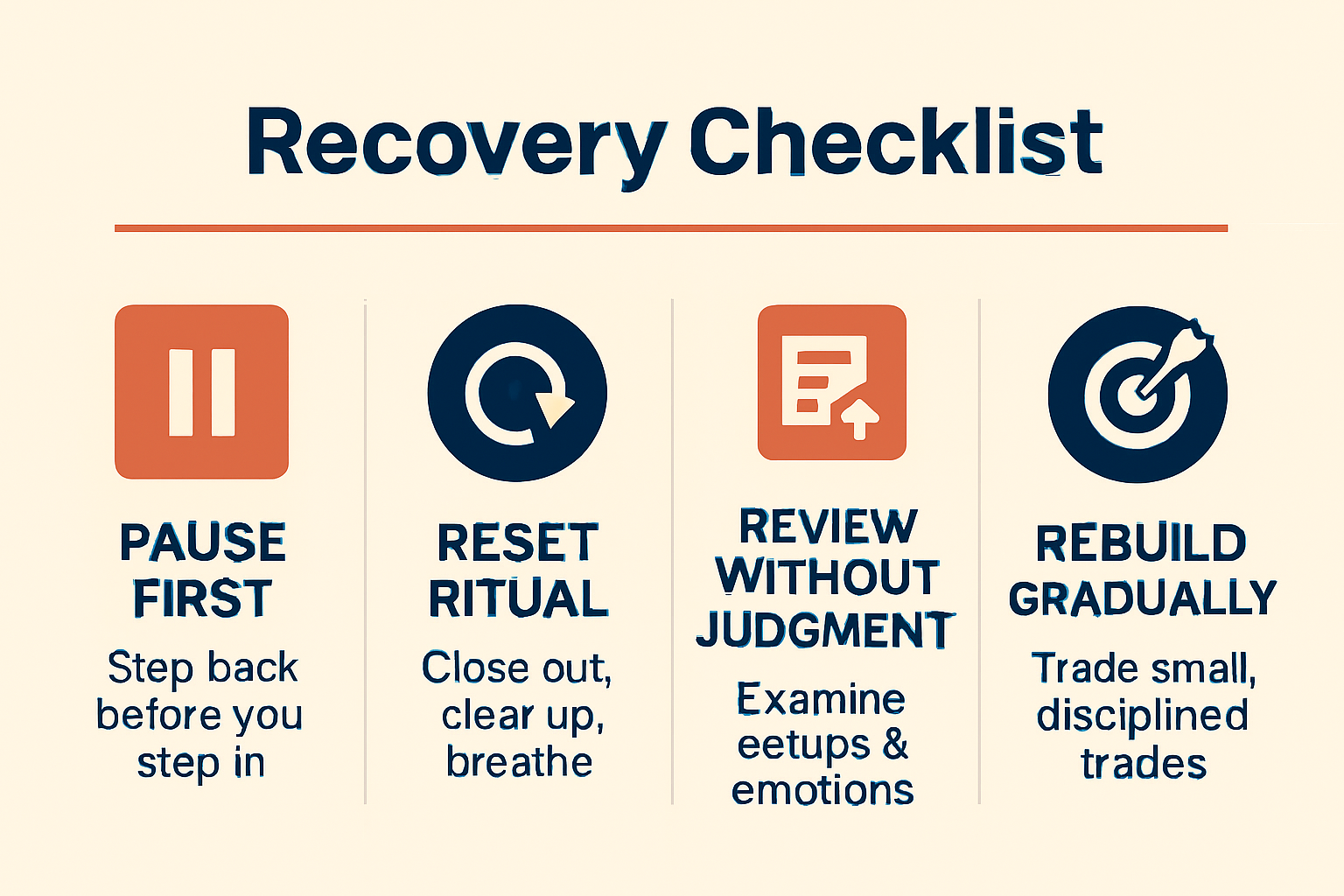
Recovery becomes easier to apply when the steps are decided before you need them. A simple routine might look like this:
Rebuild Confidence Through Process
Confidence after a difficult session should come from evidence that you can follow your process again — not simply from getting the next trade to finish green.
A profitable trade taken outside your rules can reinforce the wrong behaviour. Equally, a correctly planned and executed trade can still lose. The useful question is whether your decision-making has returned to the standard you expect from yourself.
Track Process Wins
Returning to Normal Size
Reducing position size after a difficult session can lower financial and emotional pressure while you focus on execution. Another option is to move temporarily to simulation and practise the setup without financial risk.
The important point is that returning to normal size should not depend on achieving an arbitrary number of winning trades.
Trade smaller if that is part of your predefined risk process after a drawdown or loss threshold.
Practise recognising and executing your setups without putting additional capital at risk.
Return according to predefined risk rules and evidence of consistent execution — not simply because a few trades won.
Don't Change Strategy to Chase the Loss
After a quiet or difficult session, faster-moving stocks and more aggressive setups can suddenly look attractive. Be careful not to confuse a desire for action with a valid reason to change strategy.
Increasing volatility, size or trade frequency because you want to recover money changes the plan in response to P&L.
Judge the opportunity using the same criteria you would have used before the losing trade happened.
Momentum itself isn't the problem. If momentum trading is already part of your tested approach and the setup meets your criteria, it can be evaluated normally. The problem is using a different or more aggressive style specifically because you are trying to erase a loss.
Know When Not to Trade
Sometimes the most useful recovery decision is to finish for the day. There is no requirement to take another trade simply because the market is still open.
Stopping Can Be Part of the Trading Plan
Predefined stopping rules can remove some of the judgement required when you're already frustrated or mentally tired.
A Different Perspective on Recovering From Loss
Sometimes it helps to hear another trader explain how they approach losses and drawdowns. The following third-party video discusses a four-step approach to recovering from a trading loss.
Keep One Red Day in Perspective
One red day doesn't define your trading, just as one green day doesn't prove that a strategy works. Individual sessions are small samples inside a much larger process.
That makes the post-session review more useful when it focuses on repeatable behaviour: whether you followed your rules, managed risk, recognised valid setups and responded appropriately when things went wrong.
The Aim Is Not to Erase the Red Day
The loss has already happened. Recovery means preventing that result from controlling the decisions that follow. Review it, record what you can learn from it, and return to your normal process when your predefined rules say you are ready.
Final Thoughts
Red days are part of trading. The danger is not simply that a trade lost — it's allowing frustration, urgency or the desire to get back to breakeven to dictate what happens next.
Build a repeatable reset process before you need it. Step away, review the evidence, record the trade, and judge the next opportunity by the same standards you would use on any other day.
Sometimes that means taking another valid setup. Sometimes it means reducing risk or practising in simulation. And sometimes the correct decision is simply to stop for the day.
This content is provided for educational and informational purposes only and does not constitute financial, investment or trading advice. Trading involves risk, and you can lose some or all of the money you commit to a trade.
